County Mayo
Dark Lies the IslandCounty Mayo is presented as both a remote coastal setting and the location of Sara’s solitary retreat: a designed summer house beside a bog and an Atlantic coastline that is gradually advancing inland. The landscape’s openness contrasts with the house’s glass enclosure, making place an active part of the passage’s account of isolation and mental strain.
Landscape and Setting
The house is situated across the bog from a coast that loses about a metre to the Atlantic each year. Below it, low dunes descend toward the water of Clew Bay, where hundreds of small islands appear against the grey sea. The measured coastal erosion gives the landscape a slow, continuing change, while the house occupies ground close to that advancing edge.
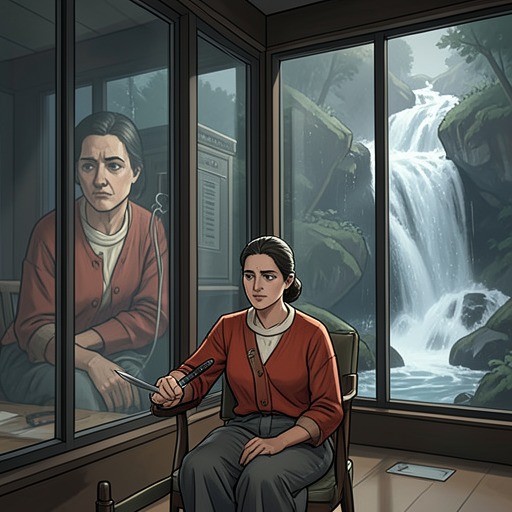
Sara’s father designed the family’s summer house around glass, angles, and small recesses that frame stark views over the bog. A stream runs through the open-plan interior beneath a thick glass floor; the house therefore places its occupants in direct visual contact with the bog water without separating the interior from it completely. The setting is not simply scenic: its unusual design makes the landscape visible from within the home.
Sara’s Retreat
Sara returns to the holiday house in an old, wine-coloured Saab after leaving town. She is staying there alone during her year out, which her father had questioned because winter was approaching; she described her plans only as art-related. Her arrival places the retreat within a period of self-directed separation rather than an ordinary family holiday.
Inside, Sara switches on the lamps and looks back through the glass doors at the illuminated, empty interior. She then turns toward the bog and coast. The sequence sets the designed house against the largely uninhabited landscape: the house is lit and visible, but no one else is present with her. She later lies on the sofa and responds to her condition with a sense of physical and mental distress.
Narrative Significance
County Mayo links Sara’s isolation to a landscape shaped by gradual change. The house is a family summer home, yet her year-out stay makes it a solitary place, and its glass construction exposes rather than shuts out the surrounding bog and coast. The annual loss of land to the Atlantic supplies a concrete counterpart to the passage’s emphasis on instability, while the empty, illuminated house sharpens the contrast between architectural design and the absence of companionship.